
If you run a business, you have probably asked yourself this question at least once:
“Where should I actually spend my marketing budget?”
SEO?
Instagram?
Google Ads?
Facebook Ads?
Content?
Or should you somehow try everything?
The problem is that most businesses don’t have an unlimited marketing budget.
You want more customers, but you also don’t want to keep spending money on different platforms without knowing what is actually helping your business.
This is where things can get confusing.
You start posting on social media because everyone says your business needs to be active there. Then you try Google Ads because you want enquiries quickly. A few months later, someone tells you that SEO is essential, so you start working on that too.
Suddenly, you are doing a little bit of everything — but you are not really sure what is working.
If you have ever been in this situation, you’re not alone.
The better way to approach SEO vs Social Media vs Paid Ads is not to ask which one is universally better.
Instead, ask:
“How do my customers actually find and choose a business like mine?”
That answer can tell you where your marketing budget deserves attention first.
SEO: Useful When Customers Are Already Searching
Let’s start with SEO.
SEO helps your website and online presence become easier for search engines to understand and discover when people search for things related to your business.
For example, imagine someone searches:
“digital marketing agency in Kochi”
If you provide digital marketing services, that person is already showing an interest in what you offer.
They are not simply scrolling through content.
They are actively looking for something.
That is one of the biggest differences when looking at SEO vs Social Media vs Paid Ads.
With SEO, you are trying to become visible when the customer is already searching.
Good SEO can involve much more than simply adding keywords to a website. It may include:
- Creating useful website content
- Improving website structure
- Fixing technical SEO issues
- Optimising important pages
- Improving internal linking
- Working on local SEO
- Answering real customer questions
- Building relevant website authority
- Making the website easier to navigate
But there is something important to remember.
SEO usually takes time.
If your industry is competitive, it can take consistent work before you see meaningful changes in search visibility.
That does not make SEO ineffective.
It simply means SEO is generally something you build over time rather than something you switch on today and expect to transform your business tomorrow.
Social Media: Useful for Getting Attention
Social media works differently.
Your potential customer may not be searching for your business at all.
They might simply come across one of your Reels.
Maybe they see a useful post.
Maybe they watch a product demonstration.
Maybe they see someone talking about your service.
They don’t contact you immediately.
Then, a few days later, they see your business again.
Eventually, your name starts becoming familiar.
That is where Social Media Marketing can be useful.
For some businesses, especially those that depend heavily on visual content or community engagement, social media can help customers understand:
- What the business does
- What the product or service looks like
- Who is behind the business
- What other customers experience
- What makes the business different
- Whether the business feels trustworthy
And you don’t necessarily need to post three times a day.
In fact, constantly publishing content just for the sake of staying active can become exhausting — for you and for your audience.
A few useful posts can be more meaningful than a large number of posts that nobody really wants to see.
So instead of asking:
“How often should I post?”
Try asking:
“What would actually be useful to my customer?”
That is a much more useful question.
When comparing SEO vs Social Media vs Paid Ads, social media is mainly about building familiarity and keeping your brand visible.
Paid Ads: Useful When You Need Targeted Reach
Paid advertising is different again.
With platforms such as Google Ads and social media advertising, you can put your business in front of a specific audience without waiting for organic visibility to build.
That can be useful when:
- You have a new offer
- You want to generate enquiries
- You are launching a product
- You have a specific target audience
- You want to test a market
- You need traffic for a particular landing page
This is one reason businesses consider a Performance Marketing Agency in Kochi when they want to focus on measurable paid campaigns.
But there is one thing I would never forget:
A click is not a customer.
You could get hundreds or even thousands of clicks and still receive very few enquiries.
Why?
Maybe the audience was not right.
Maybe the offer was unclear.
Maybe the landing page was confusing.
Maybe there was no strong reason for the visitor to take action.
Or perhaps the follow-up process was too slow.
So, when looking at SEO vs Social Media vs Paid Ads, paid advertising should not be treated as simply “pay money and get customers.”
The advertisement gets someone’s attention.
The landing page continues the conversation.
Your business then needs to turn that interest into an enquiry, conversation or sale.
Understanding SEO vs Social Media vs Paid Ads becomes easier when you look at how quickly you need to reach potential customers.
So, Which One Should You Start With?
This is where there is no single answer.
And honestly, that is probably a good thing.
Your business is different from another business.
Your customers may search differently.
Your buying cycle may be different.
Your budget may be different.
So instead of looking for one universal answer to SEO vs Social Media vs Paid Ads, start with your customer journey.
Ask yourself a few simple questions.
Do Customers Actively Search for What You Sell?
If yes, SEO may deserve serious attention.
If people regularly search for your products, services, locations or solutions before contacting a business, being visible in search can become an important part of your marketing.
This is particularly relevant when planning SEO Services in Kochi for a locally focused business.
Do Customers Discover Businesses Through Content?
If your audience spends time on Instagram, YouTube, Facebook or other social platforms, social media may play a bigger role.
This is especially useful when people need to see your brand, products or expertise several times before they feel comfortable contacting you.
Do You Need Enquiries Quickly?
Paid advertising may help you reach a defined audience faster.
But before spending heavily, make sure your offer, targeting, landing page and enquiry process are ready.
Otherwise, you may simply pay for traffic that does not turn into meaningful business.
Is Your Website Ready?
This is one question businesses often forget.
Before sending more people to your website, ask:
What do we actually offer?
Who is it for?
Why should someone care?
What makes us different?
What should the visitor do next?
A website can look beautiful and still struggle to generate enquiries if visitors cannot quickly understand what the business offers.
That is why your website should be part of your overall Digital Marketing Strategy, not something you think about separately.
What If My Marketing Budget Is Small?
This is probably the question most small business owners care about.
For a limited budget, SEO vs Social Media vs Paid Ads should be considered based on where your customers actually make decisions.
If your budget is limited, trying to do everything at once can quickly become expensive and difficult to manage.
Instead, start by understanding where your customers make decisions.
For example, one customer’s journey might look like this:
Searches on Google → Visits your website → Checks your social media → Compares competitors → Contacts your business
Another customer might have a completely different journey:
Sees an Instagram Reel → Visits your profile → Checks your website → Sees an advertisement later → Finally makes an enquiry
There is no guarantee that every customer follows the same path.
That is why SEO, social media and paid advertising do not always need to compete with each other.
They can have different jobs.
SEO can help people discover you.
Social media can help people become familiar with you.
Paid ads can help you reach a targeted audience.
Your website can bring the whole journey together.
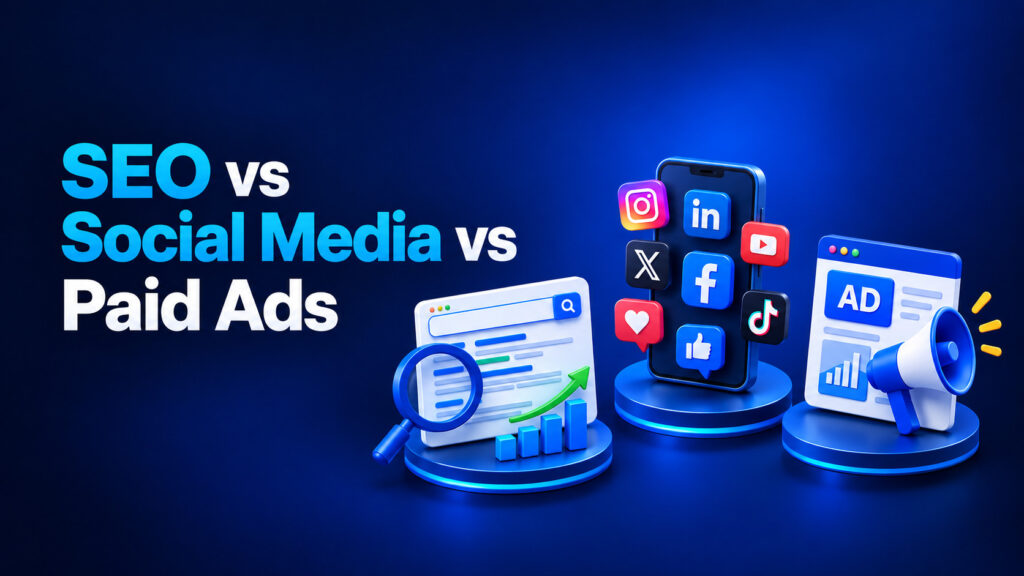
SEO vs Social Media vs Paid Ads: What Does Each One Do?
| Channel | Main Role | Useful When |
| SEO | Helps people discover your business through search | Customers actively search for your product or service |
| Social Media | Builds awareness and familiarity | Customers discover businesses through content |
| Paid Ads | Helps you reach a targeted audience quickly | You have a clear offer or campaign |
| Website | Helps visitors understand and take action | Customers need more information before enquiring |
Looking at it this way makes the decision a little easier.
You are not necessarily choosing one channel forever.
You are choosing the channel that addresses your current business problem.
Can SEO, Social Media and Paid Ads Work Together?
When businesses compare SEO vs Social Media vs Paid Ads, each channel can support a different stage of the customer journey.
Yes.
And in many cases, they can support each other.
Imagine someone discovers your business through Instagram.
They don’t contact you immediately.
A week later, they search for your business name on Google.
They visit your website.
Later, they see one of your advertisements.
Now your business is no longer completely unfamiliar to them.
This is why marketing often works more like a customer journey than one single advertisement.
SEO can help with discovery.
Social media can help with familiarity.
Paid advertising can help with targeted reach.
Your website can help turn that interest into action.
This makes SEO vs Social Media vs Paid Ads an important comparison when planning a balanced digital marketing strategy.
The important thing is understanding what role each channel is playing.
How to Measure SEO, Social Media and Paid Ads
A clear understanding of SEO vs Social Media vs Paid Ads also helps you measure each channel against the right business goals.
Another common problem is focusing only on likes, followers or website traffic.
Those numbers can be useful.
But they do not tell you everything.
If you are investing in SEO, you could look at:
- Organic traffic
- Search visibility
- Important keyword rankings
- Website enquiries
- Conversion rates
For social media, you might look at:
- Engagement
- Profile visits
- Website visits
- Enquiries
- Content performance
For paid advertising, useful metrics can include:
- Cost per click
- Cost per lead
- Conversion rate
- Enquiry quality
- Actual business outcomes
The important question is not:
“Did this post get 500 likes?”
It is:
“Did this marketing activity help move my business forward?”
That change in mindset can make your marketing decisions much clearer.
What Would I Do If I Were Starting Again?
If I were starting a business from scratch, I wouldn’t immediately put money into every marketing channel.
I would first try to understand the customer.
I would ask:
What do they search for?
Where do they discover businesses like mine?
What makes them hesitate before buying?
What information do they need before contacting me?
How are competitors reaching them?
Then I would decide where to focus.
If customers were actively searching for my service, I would pay close attention to SEO.
If customers needed to see my brand repeatedly before making a decision, I would put more effort into useful social content.
If I had a strong offer and wanted to reach a defined audience quickly, I would consider paid advertising.
And as the business grew, I would look at how all three could work together.
That, to me, is a more practical way to approach SEO vs Social Media vs Paid Ads.
Final Thoughts
If you are trying to decide whether to invest in SEO, social media or paid advertising first, don’t start with:
“Which one is the best?”
Start with:
“How do my customers find and choose a business like mine?”
That one question can completely change how you think about your marketing budget.
You may realise that SEO deserves more attention.
You may discover that your social media content needs a different approach.
You may find that paid advertising makes sense for a particular campaign.
Or you may realise that you need a combination of all three.
There is no need to market everywhere simply because other businesses are doing it.
Market where your customers are actually making decisions.
The right approach to SEO vs Social Media vs Paid Ads depends on your audience, budget and customer journey.
Understanding SEO vs Social Media vs Paid Ads can help businesses make more focused marketing decisions.
Not sure which digital marketing channel is right for your business? Talk to our team to build a strategy based on your goals, audience and budget.
Frequently Asked Questions
1. How do I choose between SEO vs Social Media vs Paid Ads?
Start by understanding how your customers discover, research and choose businesses. Consider their search behaviour, preferred platforms, buying journey, budget and immediate business goals.
2. Can SEO and Google Ads work together?
Yes. SEO can help build organic search visibility over time, while Google Ads can provide paid visibility for selected searches. Businesses can use both depending on their goals.
3. What is the difference between SEO and paid advertising?
SEO focuses on improving organic visibility in search results, while paid advertising involves paying platforms to display advertisements to a selected audience.
4. Should a small business invest in SEO or social media first?
There is no single approach for every business. If customers actively search for your products or services, SEO may deserve attention. If customers discover businesses through content and social platforms, social media may have a larger role.
5. How do I know if my digital marketing is working?
Look beyond followers and traffic. Track relevant enquiries, leads, conversions, cost per lead and other metrics connected to your actual business goals.