
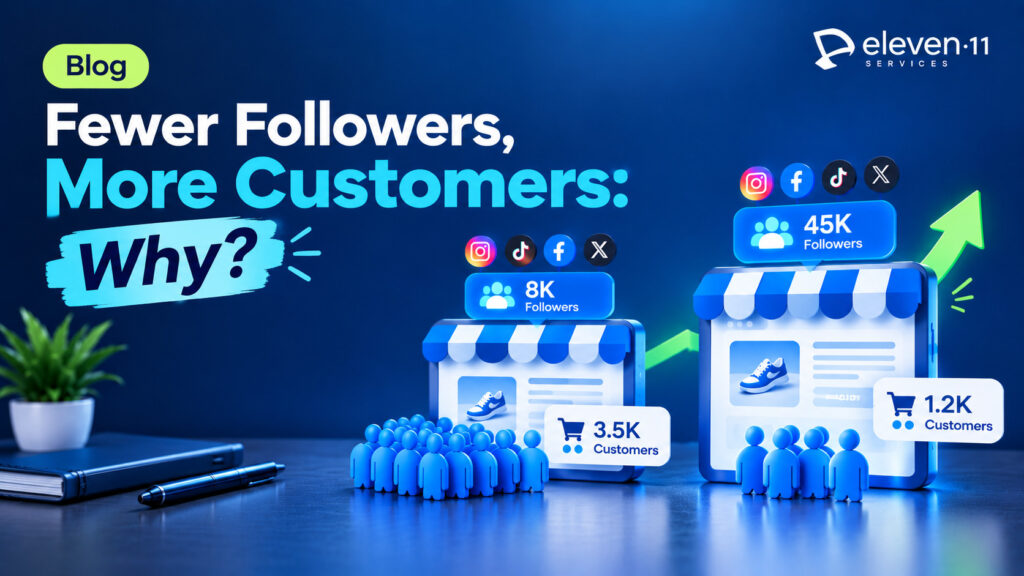
You have 15,000 followers.
Your competitor has 3,000.
You post almost every day. Your Instagram looks active, your website is running, and you are spending time and money on marketing.
Yet somehow, your competitor seems to be getting more customers than you.
If you have ever looked at a competitor’s page and thought, “How are they doing this with so few followers?”, you are definitely not alone.
It is easy to assume that the business with the bigger audience should naturally get more enquiries and sales.
But followers are only one part of the picture.
A business can have thousands of followers and still struggle to generate enquiries. At the same time, a smaller business can attract customers because it appears in the right Google search, answers the right question or makes it easier for a visitor to take the next step.
This is where a well-planned Digital Marketing Strategy becomes important.
Instead of asking only:
“How many people follow us?”
It can be more useful to ask:
“Are the right people finding us when they actually need what we offer?”
That question can tell you much more about your online presence.
A strong Digital Marketing Strategy connects these activities so they work toward the same customer goal
A clear Digital Marketing Strategy also helps you decide which channels deserve your time and budget.
Followers Don’t Always Turn Into Customers
Let’s take a simple example.
Imagine there are two businesses.
Business A has 15,000 Instagram followers.
Business B has only 3,000.
Looking at the numbers, you might assume Business A is performing better.
But now imagine someone in Kochi searches:
“Digital marketing agency in Kochi for a small business”
Or:
“SEO services for my business”
Or:
“How can I get more leads from my website?”
If Business B appears when that person is actively looking for a solution, Business B has an opportunity to get that enquiry.
The person searching may not care how many followers the business has.
They want an answer.
They want a service.
They want to solve a problem.
That is why Digital Marketing Services in Kochi should not be viewed only through social media numbers.
Customer intent matters.
Someone casually scrolling through Instagram may not be planning to buy anything.
Someone searching for a specific service usually has a reason for that search.
That difference can have a major impact on where your enquiries come from.
1. How Digital Marketing Strategy Helps Competitors Get More Customers
Think about the last time you searched for a business.
Did you scroll through hundreds of Instagram profiles?
Probably not.
You most likely searched on Google.
That is why one of the first things I would check as a business owner is:
“Can people find my business without already knowing my brand name?”
Try searching for the services you offer.
For example:
- Digital Marketing Services in Kochi
- Digital Marketing Agency in Kochi
- SEO Services in Kochi
- Social Media Marketing for Small Business
- Performance Marketing Agency in Kochi
Then look at the results as if you were a potential customer.
Can you find your business?
Does your website appear?
Does the page actually answer what the person searched for?
Is there enough useful information to make them want to learn more?
If the answer is no, having more followers may not solve the real problem.
A strong Digital Marketing Strategy should help your business become discoverable at the moments when potential customers are actively looking for solutions.
This is where SEO, useful content, local search and website optimization can work together.
You can also refer toGoogle Search Central’s SEO guidance for Google’s recommendations on creating search-friendly websites.
2. Your Competitor May Be Talking About Problems, Not Just Services
This is something many businesses overlook.
When we run a business, it is natural to talk about what we sell.
We say:
“We provide SEO services.”
Or:
“We offer social media marketing.”
But that is not necessarily how customers think.
A business owner may instead search:
“Why is my website not showing on Google?”
Or:
“Why am I getting likes but no customers?”
Or:
“How can I get more leads from my website?”
See the difference?
The first approach talks about the service.
The second approach talks about the problem.
A useful Digital Marketing Strategy should understand both.
For example, instead of publishing another generic article saying “What is SEO?”, you could create something more relevant to a real customer concern:
“Why Is My Business Not Showing on Google? 7 Things to Check.”
That type of content gives people a reason to stop and read.
You are helping them before asking them to become a customer.
And sometimes, that is how trust starts.
3. How Digital Marketing Strategy and Website Optimization Can Increase Leads
Here is another situation that happens often.
You manage to get someone onto your website.
Great.
But what happens next?
They may look around and think:
What exactly does this business do?
Is this service right for me?
Can I trust them?
How does the process work?
What should I do next?
If your website does not answer those questions clearly, the visitor may simply leave.
Your website does not need to be complicated.
It needs to make things easy to understand.
Clear service pages, useful information, genuine reviews, simple navigation and an obvious way to contact you can all make the customer journey easier.
Your Digital Marketing Strategy should make sure the website supports the customer’s next step.
This is an important part of an Internet Marketing Strategy because getting traffic is only the beginning.
You also need to think about what happens after the visitor arrives.
That is where potential Website Leads can be lost.
A visitor who understands your service, trusts the information and can easily contact you has a clearer path from website visit to enquiry.
4. Customer Intent: Why Some Visitors Are More Valuable Than Others
Not every person who visits your website is at the same stage of the buying journey.
This is where Customer Intent becomes important.
Consider these three types of searches.
Informational Intent
The person is looking for information or trying to understand something.
Examples:
- “What is SEO?”
- “How does digital marketing work?”
They may not be ready to buy yet.
They are learning.
This type of search is still valuable because useful content can introduce your business to someone who may later need your service.
Commercial Intent
The person is researching options and comparing services.
Examples:
- “Best SEO services in Kochi”
- “Digital marketing agency near me”
Here, the person is moving closer to making a decision.
They may compare websites, services, reviews, pricing information and experience before contacting a business.
Transactional Intent
The person is closer to taking action.
Examples:
- “Hire SEO agency in Kochi”
- “SEO consultant Kochi”
These searches can indicate a stronger immediate need.
This does not mean every transactional search will become a customer, but the intent behind the search is different from someone simply learning what SEO means.
Understanding these differences can improve your Digital Marketing Strategy.
Instead of creating the same type of content for everyone, you can create information for people at different stages of the decision-making process.
Your Digital Marketing Strategy can use these different search intents to guide the type of content you create.
5. How Digital Marketing Strategy and Local SEO Help Businesses Get Found in Kochi
For a local business, being visible in the right location-based searches can be especially important.
Imagine someone in Kochi searches for a service you provide.
Your competitor appears with a clear business profile, relevant information, reviews and a working website.
Your business barely appears.
The difference may not be follower count.
It may simply be who was easier to find at that moment.
If you are investing in Digital Marketing Services in Kochi, take a closer look at your local search presence.
Start with your Google Business Profile and make sure your business information is accurate and complete.
Check:
- Is your business information accurate?
- Is your business category relevant?
- Are your services listed correctly?
- Are your opening hours updated?
- Does your website link work?
- Is your location information clear?
- Are your reviews genuine and current?
- Are customers able to understand what your business offers?
Local SEO is not just about appearing somewhere on Google.
It is also about providing useful and accurate information when people are searching for businesses like yours.
For businesses serving a specific area, this can be an important part of an Online Marketing Strategy.
6. Their Content May Feel More Useful
Let’s be honest.
Most of us have seen enough posts saying:
“We are the best.”
“Choose us for the best service.”
“Contact us today.”
After a while, they all start looking the same.
Now compare that with a post that says:
“5 reasons your website may be getting visitors but no enquiries.”
That immediately gives you something useful.
You may read it because you have exactly that problem.
A customer-focused Digital Marketing Strategy should always connect useful content with what customers are actually searching for.
Instead of constantly asking:
“What should we promote today?”
Try asking:
“What problem is my customer trying to solve today?”
That small change can completely change the type of content you create.
Useful content does not have to be complicated.
Sometimes a simple explanation, checklist, example or honest answer is enough.
7. They May Have Fewer Visitors but Better Visitors
Another mistake is assuming that more website traffic automatically means more customers.
It doesn’t.
Imagine your website receives 1,000 visitors this month.
Your competitor receives 300.
At first, 1,000 sounds much better.
But what if most of your 1,000 visitors are not looking for your service?
And what if many of your competitor’s 300 visitors are actively searching for exactly what they provide?
Suddenly, the numbers look very different.
This is why Digital Marketing Services in Kochi should not be measured only by traffic.
Look at questions such as:
- Where are visitors coming from?
- What are they searching for?
- Which pages do they visit?
- Are they engaging with your content?
- Are they contacting the business?
- Are the enquiries actually relevant?
- Which channels generate meaningful leads?
Sometimes quality of traffic matters more than quantity of traffic.
A focused Digital Marketing Strategy looks beyond traffic numbers and considers whether those visitors can become relevant leads.
8. Make It Easy for Interested Customers to Contact You
Have you ever visited a website, liked what you saw and then struggled to figure out how to contact the business?
It happens more often than you might think.
Maybe there is no clear phone number.
Maybe the contact form is difficult to find.
Maybe there is no obvious next step.
Or perhaps the website gives you plenty of information but never tells you what to do next.
A customer who is ready to enquire should not have to search for the contact button.
Depending on your business, the next step could be:
- Request a consultation
- Get a quotation
- Call the business
- Send an enquiry
- Book an appointment
- Contact through WhatsApp
- Learn more about a service
A customer-focused Digital Marketing Strategy should consider the entire journey:
Search → Website → Information → Trust → Enquiry
Every step matters.
9. How Online Reputation Can Influence Customer Decisions
Imagine you are choosing between two businesses.
One has useful website information, genuine reviews and an active online presence.
The other has very little information.
Which one would you spend more time researching?
Most people want some reassurance before spending money.
That reassurance can come from different places:
Website + Reviews + Google Business Profile + Social Media + Helpful Content
Customers may check several of these before contacting you.
This is why online reputation should be considered as part of your wider Internet Marketing Strategy.
Your customer may see your Instagram post today, read your website tomorrow and check your reviews before making a decision.
All of those touchpoints become part of their impression of your business.
10. Your Competitor May Have a More Focused Strategy
This might be one of the biggest differences.
Your competitor may not actually be doing more marketing than you.
They may simply be more focused.
Instead of trying to post on every platform and talk about every service, they may have started with a few basic questions:
Who are our customers?
What are they looking for?
What problems do they have?
Where do they search?
What information do they need before contacting us?
What would make them trust us?
Then they build their content, SEO, website and social media around those answers.
That is what makes a Digital Marketing Strategy more purposeful.
Posting every day is activity.
Knowing why you are posting is strategy.
The difference is important.
A well-planned Digital Marketing Strategy brings these activities together instead of treating each marketing channel separately.
What Can You Check in Your Own Business?
If your competitor has fewer followers but seems to be getting more customers, don’t immediately panic and start posting five times a day.
Take a step back.
Look at your digital presence from the customer’s point of view.
Search Visibility
Search for your main services without typing your brand name.
Can potential customers find you?
Website
Can someone understand what you offer within a few seconds?
Content
Are you answering real customer questions or only talking about your services?
Local Search
Is your Google Business Profile accurate and complete?
Trust
Can customers easily find genuine reviews and useful information?
Enquiries
Is there a clear and simple way to contact you?
Measurement
Are you measuring enquiries, calls and conversions — or only likes and followers?
Customer Intent
Are you creating content based on what your customers actually search for?
These questions can tell you much more than your follower count.
The Question I Would Ask Instead of “How Many Followers Do We Have?”
It is easy to get caught up in numbers.
10,000 followers sounds better than 2,000.
100,000 views sounds better than 10,000.
But the real question for a business is not always about getting bigger numbers.
It is about getting the right people to take the right action.
So instead of asking:
“How many followers do we have?”
Try asking:
“Are the right customers finding us when they need our service?”
That question changes the way you look at marketing.
You start thinking about search visibility.
You start thinking about customer intent.
You start thinking about your website.
You start thinking about content.
You start thinking about trust.
And you start thinking about actual enquiries instead of just likes.
A Simple Test You Can Try This Week
Here is a simple exercise that does not require a complicated marketing report.
Open Google.
For five minutes, forget your own brand name.
Pretend you are a customer who has never heard of your business.
Now search for five questions or services your ideal customer might search for.
For example:
- Digital Marketing Services in Kochi
- How can I get more leads online?
- Why is my website not getting enquiries?
- How can I improve my Google visibility?
- How can a small business get more customers online?
Now look at the results.
Ask yourself:
Can I find my business?
Does my website answer the question?
Does the information feel useful?
Would I trust the business enough to enquire?
Is there an obvious next step?
You can also try similar questions through an AI-powered search experience where available.
You may find gaps in your online presence that your follower count never showed you.
Final Thoughts
Having fewer followers does not automatically mean your competitor is doing everything better.
And having more followers does not automatically mean your business will get more customers.
The bigger picture is how well your online presence connects:
The right customer → The right problem → The right information → The right next step
A practical Digital Marketing Strategy should focus on visibility, relevant visitors, useful content and clear conversion paths.
So, before you compare your follower count with your competitor’s, take a closer look at what is happening behind those numbers.
Can people find you?
Does your content answer their questions?
Does your website build confidence?
Are you attracting relevant visitors?
Is it easy to contact you?
Are you measuring actual enquiries?
Because sometimes, your competitor does not have more attention.
They may simply be easier to find when someone is ready to take action.
Want to know why your website is getting traffic but not enough enquiries?
A detailed SEO and digital marketing audit can help identify gaps in search visibility, content, website experience and conversion opportunities.
Frequently Asked Questions
1. Why does my competitor get more customers than me?
A competitor may be reaching customers through stronger search visibility, relevant content, local SEO, a clearer website experience, stronger trust signals or a simpler enquiry process. Follower count alone does not show the complete customer journey.
2. Can a business get customers without having many followers?
Yes. Businesses can attract customers through search engines, local SEO, referrals, websites, content marketing, paid advertising and other channels. A large social media following is not required for every customer acquisition strategy.
3. Do Instagram followers affect sales?
Instagram followers can contribute to awareness, engagement and customer relationships, but follower numbers do not automatically translate into sales. Relevance, customer intent, content quality and the path from social media to enquiry also matter.
4. How can SEO help generate more leads?
SEO can help potential customers discover relevant pages when they search for products, services or solutions. When search visibility is combined with useful content and a clear website experience, organic traffic can have opportunities to become enquiries.
5. Why is my website getting traffic but no leads?
Possible reasons include attracting visitors who are not the right audience, unclear service information, weak trust signals, poor website experience or a difficult enquiry process. Reviewing both traffic quality and conversion paths can help identify where potential leads are being lost.
6. How can I improve my local SEO in Kochi?
7. What is Customer Intent in digital marketing?
Start by making sure your business information is accurate and consistent, maintaining your Google Business Profile, creating useful location-relevant content and ensuring your website clearly communicates your services and service area.
Neither number should be considered on its own. Look at whether your audience and website visitors are relevant and whether they take meaningful actions such as making enquiries, calling, booking or purchasing.
Customer Intent refers to what a person is trying to accomplish when they perform a search. Someone searching “What is SEO?” has a different intent from someone searching “Best SEO services in Kochi” or “Hire SEO agency in Kochi.”
8. Should I focus on followers or website traffic?
9. Does every business need Social Media Marketing?
Not necessarily in the same way. The right approach depends on your audience, industry, goals and where potential customers spend time or search for information.
10. What should I measure in my digital marketing efforts?
Depending on your goals, you can track search visibility, relevant website traffic, engagement, qualified enquiries, calls, form submissions, conversion rates and customer acquisition. These metrics can provide more useful business insight than follower counts alone.